


GE MPU55 Nexus Controller: Powerful Control Intelligence for Modern Industrial Systems
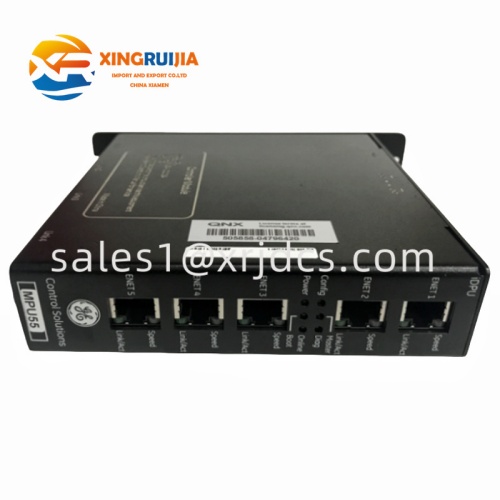
Modern industrial control systems require dependable processing, precise coordination, and reliable communication between controllers and field devices. In applications where continuous operation matters, the controller is more than a processing component. It serves as a central point for managing system logic, coordinating connected modules, and maintaining communication across the automation architecture.
The GE MPU55 is a Nexus Controller used within GE's advanced control platform. GE Vernova documentation identifies the MPU55 as a controller module and lists variants including MPU55-CBACN and MPU55-CBAUS. The same documentation specifies a 21.6–26.4 VDC supply range and 7.2 W power consumption for these controller variants.
For industrial operators maintaining GE control systems, this controller represents an important part of the overall processing architecture. Its role allows connected I/O, communication, and application-specific modules to operate as part of an integrated control environment.
A Controller at the Heart of the Nexus Architecture
The Nexus platform uses a modular approach to industrial control. Instead of placing every function into one large hardware assembly, the system can combine controller modules with dedicated analog input, analog output, digital input, digital output, communication, and specialized control modules.
GE Vernova's official documentation lists the MPU55 alongside a range of Nexus modules. These include analog input modules, analog output modules, digital input modules, digital output modules, valve position control modules, extension modules, and programmable logic control modules.
This modular architecture allows system designers to create a control solution around the requirements of the application.
The controller therefore provides the processing foundation while other modules handle specialized field-level functions. Such an arrangement can make the overall system easier to configure and maintain.
Designed for Modular Industrial Control
One of the defining characteristics of the Nexus platform is its separation of processing and I/O functions.
A typical control architecture may need to acquire analog measurements, monitor digital states, generate control outputs, communicate with other equipment, and execute application logic. Rather than requiring a single universal hardware module to perform every task, the Nexus architecture provides dedicated modules for these functions.
The MPU55 works within this modular environment as the controller. GE's certification documentation specifically identifies it as a Nexus Controller, while related modules provide the input and output functions required by the application.
This approach can provide engineers with greater flexibility when building or maintaining an industrial control system.
Electrical Characteristics
Power requirements are an important consideration when replacing a controller in an established industrial installation.
According to GE's Nexus OnCore module documentation, the MPU55-CBACN and MPU55-CBAUS versions operate from a 21.6–26.4 VDC supply and have a listed power consumption of 7.2 W.
These figures are useful when checking the power distribution design of an existing system. Before installation, however, engineers should always verify the exact hardware variant and the requirements of the surrounding equipment.
Power quality can also influence the reliability of an industrial controller. The associated DC supply, distribution system, grounding arrangement, and protection devices should therefore be checked as part of a complete maintenance procedure.
Working With Dedicated I/O Modules
The MPU55 is not designed to replace every field interface in the system. Instead, it operates within a broader Nexus architecture that can include dedicated I/O modules.
GE documentation lists several compatible module types. For example, the platform includes mA/V analog input modules, thermocouple/RTD input modules, analog output modules, digital input modules, and digital output modules. Specialized modules are also available for valve position control and programmable logic applications.
This separation provides a clear relationship between control processing and field signal handling.
For engineers, that structure can simplify system planning. A project can use the controller together with the I/O modules that match its instrumentation requirements rather than adopting an oversized fixed architecture.
Applications in Industrial Control
A modular controller platform can support demanding industrial applications where multiple field signals and control functions need to operate together.
Potential application environments include:
- Gas and process control systems
- Industrial machinery
- Turbomachinery-related control applications
- Power and utility facilities
- Process plants
- Manufacturing systems
- Industrial monitoring systems
- Equipment protection and control
- Distributed control architectures
- Specialized energy applications
The exact application depends on the installed Nexus configuration and associated modules.
For facilities with established GE control equipment, retaining the existing architecture can sometimes be more practical than replacing an entire control system. A compatible controller can help extend the useful service life of the surrounding hardware when the overall system remains suitable for the process.
Why Controller Availability Matters
A controller failure can have a wider impact than the failure of a single field I/O point. Since the controller provides processing functions for the control architecture, an unavailable controller may prevent multiple connected modules from performing their intended tasks.
This makes spare-parts planning particularly important.
Industrial plants often operate equipment for many years. During that period, some components may become difficult to source, especially when the system belongs to an earlier generation of control technology.
Maintaining a suitable spare controller can reduce response time when an unexpected failure occurs. It also gives maintenance teams an opportunity to verify the replacement before an emergency situation develops.
Replacement Planning for Existing Systems
Replacing an industrial controller should always begin with identification of the complete installed configuration.
The product designation should be checked together with the hardware revision, catalog number, power requirements, connected modules, communication arrangement, and application configuration.
GE's official documents distinguish MPU55 variants such as MPU55-CBACN and MPU55-CBAUS. Other GE documentation identifies MPU55 by catalog number and describes it as a Nexus Controller.
Third-party industrial automation listings also associate MPU55 with catalog numbers such as 369B1860G0030. Because industrial components can have different regional, certification, or hardware variants, buyers should verify the complete identification information on the existing unit before ordering.
A clear photograph of the product label can also help suppliers confirm the requested version.
Maintenance Strategy for Long-Service Equipment
Preventive maintenance can reduce the impact of controller-related failures. For a critical automation system, maintenance personnel can record the controller identification, associated I/O modules, power supply configuration, communication connections, and software information.
Keeping this information organized makes future troubleshooting more efficient.
It is also useful to maintain critical spare parts in advance. If a controller becomes unavailable unexpectedly, having a verified replacement on hand can shorten the time between failure identification and system restoration.
For older industrial systems, this approach can be especially valuable because sourcing lead times may vary considerably for legacy components.
Our Industrial Automation Supply Service
Our company specializes in supplying industrial automation spare parts for customers maintaining existing control systems. Our product range covers PLC modules, DCS components, controllers, I/O modules, communication boards, power modules, drives, interface cards, and other industrial automation equipment.
For customers looking for GE Nexus components, our team can assist with product identification based on the model number, catalog number, product label, photographs, and existing system configuration.
We also support customers who need rare, discontinued, or difficult-to-source automation parts. This is particularly useful for industrial facilities that need to maintain an established control platform without immediately replacing the complete system.
Our company focuses on competitive pricing, quality assurance, and responsive service. We also provide a 15-day replacement commitment for quality-related problems, giving customers additional support when purchasing industrial automation spare parts.
A Practical Choice for Nexus System Maintenance
The GE MPU55 is an important controller within the Nexus architecture. GE Vernova officially identifies the product family as a Nexus Controller and documents it alongside a broad selection of dedicated input, output, communication, and specialized control modules.
Its documented 21.6–26.4 VDC operating supply and 7.2 W power consumption provide useful reference points for system engineers checking replacement requirements.
For maintenance teams, the main value of a controller spare lies in preserving the existing control architecture when reliable replacement hardware is required. Correct identification remains essential, particularly where multiple hardware or certification variants exist.
Our company can support customers with sourcing GE Nexus controllers and other industrial automation components, helping maintain established control systems with reliable spare-parts supply and practical replacement assistance.