


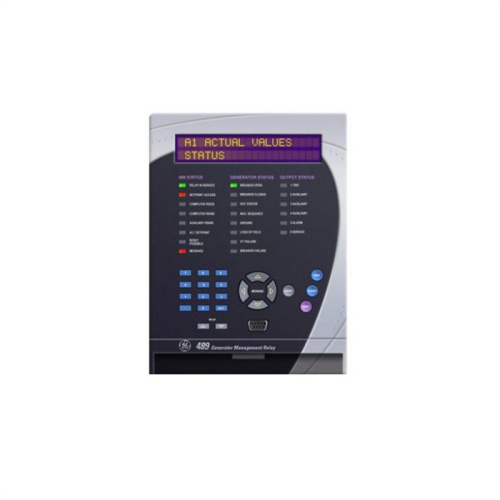
GE SR750-P1-G1-S1-HI-A20-G: The Next-Generation Feeder Protection Relay with Advanced Intelligence
Introduction
In the evolution of power system protection, the shift from electromechanical relays to microprocessor-based numerical relays has been transformative. The latest generation pushes beyond basic protection, embedding advanced condition monitoring, communication, and data intelligence directly into the relay. The GE SR750-P1-G1-S1-HI-A20-G represents this evolution—a sophisticated Feeder Protection Relay from GE's Multilin™ SR Series. This device is not just a protector; it is a smart grid sensor and a data node, crucial for modernizing distribution and sub-transmission networks.
Model Number Decoding: A Modular Configuration
The SR750's alphanumeric suffix is a detailed configuration code:
SR750: Base model, a 7-series feeder protection relay.
P1: Power Supply = 100-240V AC/DC (wide range).
G1: Case Style = Standard 19-inch rack-mount case.
S1: Display = Monochrome graphical LCD with keypad.
HI: Communication Option = Dual Ethernet ports + RS485 serial port.
A20: Hardware Option = Specific analog/digital I/O configuration (e.g., 6 analog inputs, 16 binary inputs, 10 relay outputs).
G: Firmware/Function Set = Comprehensive feeder protection suite (e.g., Includes advanced features like harmonic analysis, waveform recording).
Functional Deep Dive: Beyond Overcurrent
While its core mandate is feeder protection (50/51, 50N/51N), the SR750 is a multi-function platform:
Advanced Protection Elements:
Directional Overcurrent (67/67N): Essential for looped or networked distribution systems.
Voltage-Based Elements: Under/Over Voltage (27/59), Frequency (81O/U), for system-wide health monitoring.
Automation Logic: Integrated Programmable Scheme Logic (PSL) allows for custom control sequences (e.g., automatic transfer schemes, load shedding) without an external PLC.
Power Quality & Metering: Provides Class 0.2 accuracy for all key electrical parameters (V, I, kW, kVAR, PF, THD, harmonics up to the 31st). This transforms it from a protector to a revenue-grade metering and diagnostic device.
Disturbance Analysis: Captures high-resolution oscillographic records, event logs, and fault reports, invaluable for post-mortem analysis and reducing Mean-Time-To-Repair (MTTR).
Cyber-Secure Communications: Dual Ethernet ports support IEC 61850 (GOOSE and MMS), DNP3.0, and Modbus TCP/IP simultaneously. This enables seamless integration into modern digital substations (IEC 61850 process bus ready) and SCADA/EMS systems.
System Integration in a Digital Substation
In a contemporary substation design:
Process Bus Integration: The SR750 can receive sampled values (SV) from merging units via its Ethernet ports, eliminating traditional hardwired CT/VT connections.
GOOSE Messaging: It can send and receive GOOSE messages for high-speed, peer-to-peer communication with other relays (e.g., to receive a block signal from a busbar relay or send a trip command to a breaker IED).
Station Bus Role: It acts as an intelligent node on the station LAN, communicating with the HMI (via IEC 61850 MMS) and the Remote Terminal Unit (RTU) or Gateway.
Configuration & Engineering Workflow
The relay is configured using GE's EnerVista™ software suite, specifically EnerVista UR Setup.
Settings Management: All protection elements, thresholds, and time curves are set here. Software includes setting calculation wizards and coordination plotting tools.
Logic Configuration: The PSL is programmed using a graphical, function-block-based editor.
Data & Event Analysis: EnerVista LaunchPad is used to retrieve waveforms, events, and meter logs for analysis. Settings can be version-controlled and audited.
Typical Application: Industrial Power Plant Incoming Feeder
Protecting the main 13.8kV incoming feeder to a large industrial plant:
Protection: Provides instantaneous and time-delayed phase and ground overcurrent protection for the cable. Directional elements coordinate with the utility's upstream relay.
Control: PSL logic manages the main breaker and the tie-breaker to a second incoming source for automatic bus transfer.
Monitoring: Continuously logs power consumption, voltage sag/swell events, and harmonic distortion, providing data for energy management and power quality compliance reporting to the utility.
Maintenance & Lifecycle Perspective
Cyber Security: As a network-connected device, robust security configuration is mandatory. This includes disabling unused ports, setting strong passwords, implementing VLANs, and applying regular firmware updates from GE to patch vulnerabilities.
Condition-Based Maintenance: The relay's self-diagnostics and historical data (like cumulative breaker operations) enable a shift from time-based to condition-based maintenance.
Replacement Strategy: The modular, configurable design of the SR series simplifies replacements. The configuration file from an old relay can be loaded into a new unit, drastically reducing commissioning time.
Conclusion: The Intelligent Edge of the Grid
The GE SR750-P1-G1-S1-HI-A20-G is a paradigm of modern protection engineering. It consolidates protection, control, measurement, and communication into a single, ruggedized platform, serving as a key data source for grid digitalization and the Industrial Internet of Things (IIoT). For engineers, specifying and mastering this device is not just about protecting an asset; it's about enabling a smarter, more resilient, and data-rich power infrastructure.